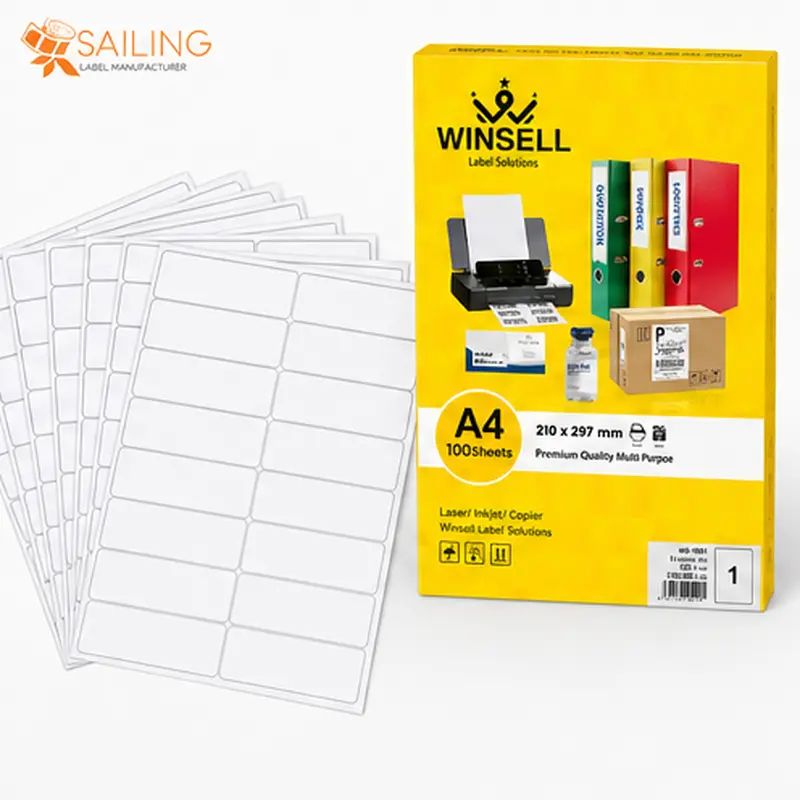
A4 label are widely used in offices, warehouses, retail stores, manufacturing facilities, and logistics operations. Their standard sheet format makes them convenient for printing shipping addresses, product information, barcodes, inventory details, and identification labels. Businesses can use compatible office printers to produce labels in-house, making this format a flexible option for everyday labeling requirements.
However, choosing the right A4 label involves more than selecting a sheet that fits a printer. Material quality, adhesive performance, label dimensions, printer compatibility, and application conditions all influence the final result. For wholesalers, distributors, and businesses purchasing in bulk, understanding these factors helps reduce printing waste, avoid application problems, and maintain consistent quality.
Quick Answer: What Should You Consider When Buying A4 Label?
Before purchasing A4 label, businesses should evaluate five important factors:
- Material: Choose paper, synthetic, PP, or transparent film according to the application.
- Adhesive: Select permanent or removable adhesive based on the surface and required bonding period.
- Sheet layout: Confirm individual label dimensions, spacing, and the number of labels per sheet.
- Printer compatibility: Make sure the sheets are suitable for inkjet or laser printing.
- Supplier reliability: Review samples, quality checks, packaging, and customization options before placing bulk orders.
The best A4 label is not necessarily the one with the lowest price. It is the one that matches the printing equipment, application surface, and business requirements.
1. Understand What A4 Labels Are Used For
An A4 label refers to an individual self-adhesive label used for product identification, shipping, organization, and other printing applications. An A4 label sheet, in contrast, is the complete sheet of label paper that follows the standard A4 dimensions of 210 × 297 mm. It contains multiple individual labels arranged in a specific layout, allowing businesses to print several labels in one operation.
An A4 label sheet generally consists of three main layers: a printable face material, an adhesive layer, and a backing liner. The face material receives the printed information, the adhesive helps the label stick to the intended surface, and the backing liner protects the adhesive until the label is ready to be used.
After printing, individual labels can be peeled from the backing liner and applied to products, cartons, documents, or other surfaces. Depending on the material and adhesive selected, A4 label sheets can be used with compatible inkjet or laser printers.
Common applications include:
- Shipping and address labels: Used for recipient details, delivery addresses, tracking information, and parcel identification.
- Product labels: Display product names, specifications, pricing, ingredients, and identification information.
- Barcode labels: Support inventory tracking, stock management, product identification, and scanning.
- Office labels: Help organize folders, files, documents, and storage systems.
- Warehouse labels: Identify shelves, cartons, storage locations, and inventory.
- Retail labels: Provide product information, pricing, and promotional details.
One of the main advantages of A4 label sheets is their flexibility. Businesses can update designs and print new information whenever necessary instead of ordering a separate batch of pre-printed labels. They can also select different label sizes, layouts, materials, and adhesive options according to their printing equipment and application requirements.
When purchasing A4 label sheets, buyers should consider the individual label dimensions, number of labels per sheet, face material, adhesive performance, backing liner, and printer compatibility. These details help ensure that the selected product meets the requirements of its intended application.
2. Choose the Right A4 Label Material
Material selection should depend on the product surface, printing method, and environment in which the label will be used. A label for office documents does not necessarily require the same construction as one used on packaging or containers.
Paper A4 Label
Paper is a practical option for general-purpose labeling. It provides a printable surface for text, barcodes, and graphics, making it suitable for offices, retail operations, shipping, and everyday packaging.
Matte paper is often preferred when readability is important because its surface produces less glare. Semi-gloss paper offers a smoother appearance and can be suitable for applications where presentation matters.
Standard paper labels are generally better suited to indoor applications. Their resistance to moisture, friction, and tearing depends on the paper grade and any additional coating.
Synthetic and PP Labels
Synthetic materials are worth considering when labels need greater resistance to moisture and handling. PP and other film-based materials can offer advantages over ordinary paper in applications where durability is important.
They may be suitable for product identification, packaging, and selected industrial uses. However, buyers should confirm the actual performance specifications rather than assuming every synthetic label provides the same level of water, chemical, or abrasion resistance.
Transparent A4 Label
Transparent labels are useful when businesses want printed information to appear directly on a product surface without a visible white background. They can be considered for selected packaging, containers, and retail products.
The color of the surface underneath the label should be considered carefully because it can affect text visibility and overall appearance.
3. Select the Correct Adhesive for Your Application
The adhesive is just as important as the face material. Even a well-printed label may fail if its adhesive cannot maintain contact with the intended surface.
Before choosing an adhesive, buyers should consider the surface type, expected application life, and environmental conditions.
Permanent Adhesive
Permanent adhesive is generally used when labels are expected to remain attached during normal product handling, storage, and distribution. It is commonly considered for shipping cartons, product identification, and general packaging.
However, adhesive performance can vary between smooth cardboard, coated packaging, plastic, and textured surfaces. Testing on the actual application material is recommended.
Removable Adhesive
Removable adhesive is useful when labels need to be taken off without leaving excessive residue or damaging the surface. It may be suitable for temporary identification, office organization, price marking, and selected retail applications.
Removal performance depends on the adhesive formulation, surface condition, temperature, and the length of time the label remains attached.
Important Adhesive Selection Factors
| Factor | What Buyers Should Check |
| Application surface | Cardboard, plastic, paper, glass, or coated material |
| Bonding requirement | Permanent attachment or temporary labeling |
| Environment | Indoor conditions, moisture, heat, or cold |
| Removal needs | Whether clean removal is required |
| Application method | Manual application or automated handling |
Evaluating these details helps buyers select a label construction that performs reliably in its intended environment.
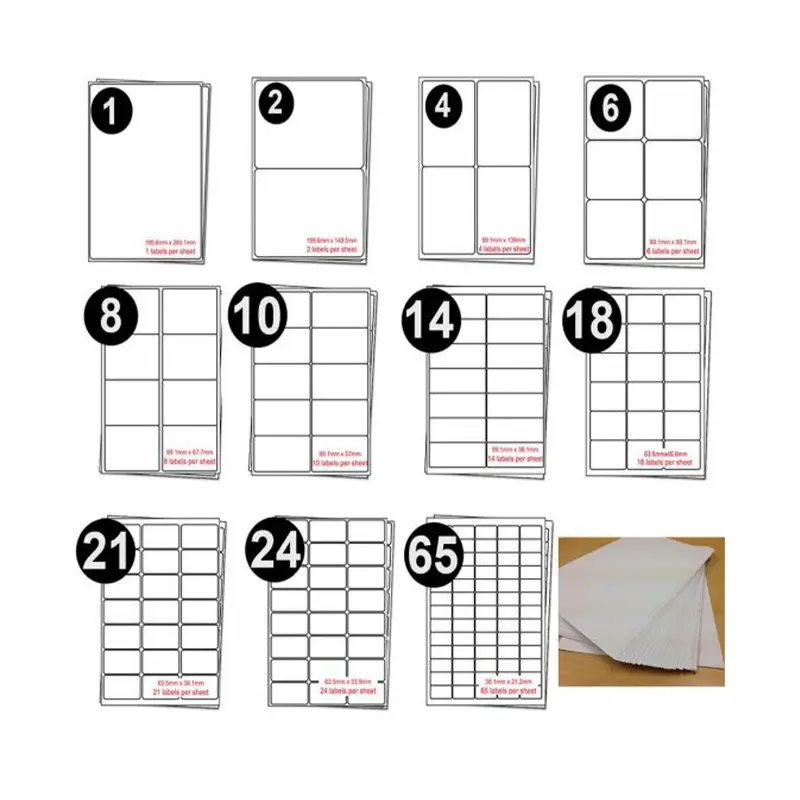
4. Choose the Right A4 Label Sheet Dimensions and Layout
A4 label sheets are available in different configurations. Some contain a few large labels, while others are divided into several smaller sections. The correct arrangement depends on the amount of information being printed, the type of application, and the size of the surface receiving the label.
Different business activities require different label layouts. For example:
- E-commerce and shipping: Online retailers and fulfillment centers often need medium or large labels with enough space for recipient names, delivery addresses, tracking numbers, and barcodes. A layout with fewer, larger labels can be suitable for printing shipping information clearly.
- Retail product packaging: Businesses labeling bottles, boxes, jars, and retail packages may prefer smaller or medium-sized labels. These provide space for product names, prices, SKU numbers, and other essential details without covering too much of the packaging.
- Warehouse and inventory management: Warehouses often use labels to identify storage shelves, cartons, bins, and inventory locations. Larger labels can accommodate bold text, product codes, and barcodes that employees need to read or scan quickly.
- Office filing and document organization: Offices may use smaller labels for file folders, document boxes, envelopes, and storage cabinets. Multiple labels on one A4 sheet allow employees to print several identification labels in a single operation.
- Product identification and barcode printing: Manufacturers and distributors may require compact labels containing product codes, batch references, or barcodes. The layout should provide enough space for accurate printing and reliable scanning.
Before ordering, confirm the following specifications:
- Overall A4 sheet size: 210 × 297 mm.
- Individual label width and height.
- Number of labels arranged on each sheet.
- Horizontal and vertical spacing.
- Top, bottom, and side margins.
- Corner shape and cutting accuracy.
These measurements are important because an incorrect layout can cause text or barcodes to print outside the intended label boundaries. Buyers should also check whether the sheet layout matches their printer settings and label design software. Testing a sample sheet before placing a large order can help identify alignment issues and reduce printing waste.
5. Check Printer Compatibility Before Purchasing
Printer compatibility is one of the most important considerations when buying printable A4 label. A label sheet designed for one printing technology may not perform properly in another.
Inkjet Printer Compatibility
Inkjet printers use liquid ink to produce text and images. The label surface must hold or absorb the ink correctly to prevent spreading, smudging, or slow drying.
Businesses using inkjet printers should select labels specifically identified as suitable for this printing method.
Laser Printer Compatibility
Laser printers use heat and toner to create printed images. A4 label intended for laser printing must be suitable for the printer’s operating temperature and feeding process.
An unsuitable adhesive or backing liner may cause feeding problems or leave residue inside the printer. Buyers should confirm compatibility before using a new label product.
Test Printing Before Bulk Use
Even compatible labels can produce poor results if the document template and printer settings do not match the sheet layout. Print a sample sheet and check:
- Text and barcode clarity.
- Alignment with individual label boundaries.
- Paper feeding and printer handling.
- Ink drying or toner adhesion.
- Any curling, lifting, or adhesive leakage.
A sample test can identify problems before a business prints hundreds or thousands of labels.
6. How to Evaluate A4 Label Quality Before Bulk Purchasing
For wholesalers and distributors, checking samples before placing a large order is a practical way to reduce purchasing risks. Quality should be evaluated through actual use rather than appearance alone.
Important inspection points include:
Sheet dimensions and cutting: Confirm that the sheet and individual labels match the agreed measurements. Inconsistent cutting can make labels difficult to peel and affect print alignment.
Adhesive performance: Apply sample labels to the intended surface. Check whether the edges remain attached and whether the label lifts, slips, or leaves unwanted residue.
Printing performance: Print text, graphics, and barcodes using the intended printer. Review clarity, alignment, smudging, and feeding behavior.
Backing liner: The liner should support easy peeling without unnecessary tearing, curling, or damage to the label.
Packaging condition: Sheets should arrive flat, clean, and protected from moisture and physical damage.
For repeat orders, buyers should keep an approved sample and written specifications as a reference for future purchases.
7. Choosing Sailingpaper for A4 Label Supply
When sourcing A4 labels from an overseas supplier, buyers should evaluate more than the unit price. Consistent specifications, manufacturing experience, sample availability, communication, and reliable order handling are important for building long-term purchasing relationships.
A suitable manufacturer or supplier should be able to explain its available materials, adhesive options, sheet configurations, and printer compatibility. Buyers should also ask how label dimensions, printing quality, and cutting consistency are checked during production.
For international purchasing, confirm carton quantities, packaging methods, production schedules, shipping arrangements, and documentation requirements for the destination market. It is also useful to understand the manufacturer’s production resources before committing to recurring or large-volume orders.
SailingPaper offers A4 self-adhesive label options for different business applications, including address, product, and printable label sheets. Its listed material options include matte paper, semi-gloss paper, transparent film, synthetic paper, and PP. Buyers can discuss material, size, adhesive, and color requirements according to their intended applications.
According to the company’s official website, SailingPaper has more than 19 years of production experience, over 100 employees, and operates through 6+ production plants. Its listed equipment includes 40 advanced slitting machines, 10 die-cutting machines, and 5 printing presses. The company also reports shipping approximately 1,560 containers annually and exporting its products to more than 105 countries. These figures provide buyers with an overview of its manufacturing resources and international supply experience.
For A4 label buyers, these capabilities are relevant when discussing customized sheet layouts, label processing, printing requirements, and bulk supply arrangements. However, buyers should confirm the specific production schedule, available materials, and order capacity for their required A4 label specifications directly with the company.
Businesses looking for product details can explore SailingPaper A4 Label to review available options and discuss suitable specifications for their purchasing requirements.
Before placing a bulk order, requesting samples and confirming product dimensions, adhesive performance, printer compatibility, packaging, pricing, and delivery arrangements can help reduce sourcing risks.
8. Proper Storage and Handling of A4 Label
Storage conditions can influence both the label material and adhesive performance. High humidity may cause paper sheets to absorb moisture, while excessive heat can affect adhesive behavior. Dust and direct sunlight can also reduce product quality during extended storage.
To maintain product condition:
- Keep label sheets in their original packaging until use.
- Store them in a clean, dry environment.
- Avoid direct sunlight and excessive heat.
- Keep cartons away from moisture and dust.
- Avoid placing heavy objects on top of label cartons.
- Use older inventory before newer stock where practical.
For businesses managing large inventories, proper storage helps maintain consistent handling and reduces avoidable material waste.
Frequently Asked Questions About A4 Label
What is the standard size of an A4 label sheet?
The standard A4 sheet measures 210 × 297 mm. Individual label dimensions and the number of labels per sheet depend on the selected layout.
Can A4 label be used in both inkjet and laser printers?
Some A4 label are designed for inkjet printers, while others are made for laser printers. Certain products may support both printing methods, but compatibility should be confirmed with the supplier.
Are A4 label suitable for shipping and logistics?
Yes. They are commonly used for shipping addresses, parcel identification, barcodes, and warehouse information. The material and adhesive should match the packaging surface and transportation conditions.
Can businesses order customized A4 label sheets?
Depending on the supplier’s production options, buyers may request different label dimensions, sheet layouts, materials, colors, and adhesive types. Available specifications should be confirmed before production.
What should wholesalers check before placing a bulk order?
Wholesalers should review samples, printer compatibility, adhesive performance, sheet dimensions, cutting accuracy, packaging, and agreed product specifications. These checks help reduce inconsistencies between orders.
Final Takeaway
Choosing the right A4 label requires careful consideration of material, adhesive, sheet layout, printer compatibility, and intended application. A suitable combination can improve printing efficiency, reduce material waste, and help labels remain readable and securely attached.
For distributors, retailers, and businesses purchasing in bulk, testing samples and confirming specifications before ordering are essential steps. Working with a supplier that can explain its available materials and customization options makes it easier to source A4 label that meet operational requirements and support long-term business needs.