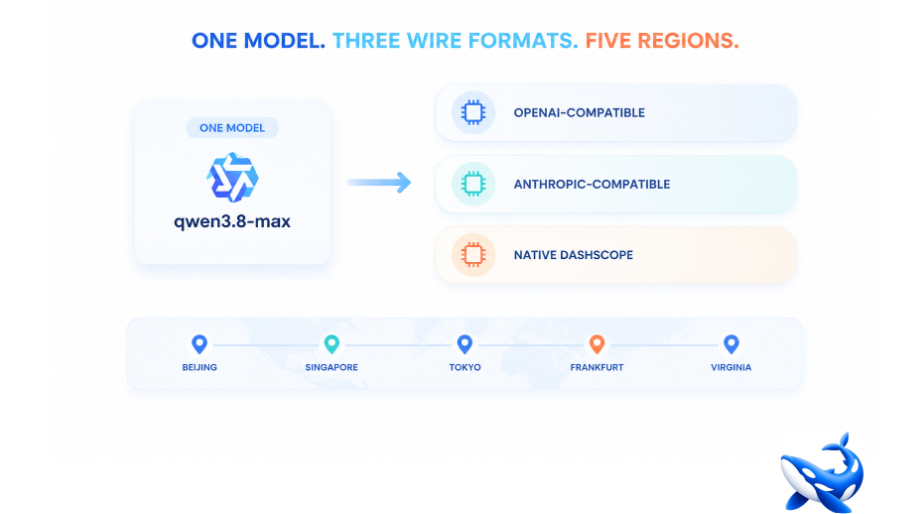
The same model can wear three different protocols, and that is the first thing the page says. The model page for Qwen3.8 Max states that it can be called through three wire formats — OpenAI-compatible, Anthropic-compatible and native DashScope — across five regions: Beijing, Singapore, Tokyo, Frankfurt and Virginia [VENDOR]. For anyone comparing through OrcaRouter‘s Qwen API catalogue, this matters in a specific way: the page is describing one model with three interoperable faces, not three models, and which face you use changes the shape of your request without changing what runs behind it [OURS].
Two calibres, stated before they collide
Before the formats, the catalogue asks you to hold two numbers that do not mix. The model page’s context block lists 1,000,000 tokens for Qwen3.8 Max — that is the model-page calibre [VENDOR]. The provider page’s FAQ, speaking conversationally, names Qwen3.6 Plus as the largest context in the Qwen catalogue at 1048K tokens — a different model, a different page, and a different rounding of the same order of magnitude [VENDOR]. Neither number is wrong; they are simply measured on different pages. The rule for reading this catalogue is to state which page each context figure comes from and never fold the two into one sentence [OURS].
The catalogue math is otherwise plain. The Qwen provider page counts 27 models, and the capability census runs 22 with vision, 24 with tools, 23 with reasoning and 24 with JSON mode [OURS]. The cheapest input rate across those 27 is $0.100 per million tokens on qwen/qwen3.5-flash, and the median p50 latency across the catalogue is 4,000 ms [OURS]. The pages give prices and counts, and they do not give everything — more on that in a moment [OURS].
Three faces of one model
Qwen3.8 Max is priced at $2.00 per million input tokens and $6.00 per million output tokens, accepts text, images and video, and carries a 1,000,000-token context on the model page [VENDOR]. The three wire formats are the part worth unpacking, because they are three different request shapes for the same capability. An OpenAI-compatible call sends `messages` with a `model` field in the familiar shape. An Anthropic-compatible call speaks the other dialect, with `max_tokens` and system framing. A native DashScope call is the Qwen-native format, for callers already inside the vendor’s own ecosystem [OURS]. None of the three changes the model that serves the request; all three change the client code that builds it. If your stack already speaks one dialect, this model lets you keep your client and change your model — which is precisely the property a gateway catalogue exists to surface [OURS].
The five regions are the deployment side of the same flexibility. Beijing, Singapore, Tokyo, Frankfurt and Virginia are five landing zones, and the region you pick is a data-residency decision as much as a latency one [VENDOR]. The page names the regions but does not publish latency per region — the closest published figure is the catalogue median of 4,000 ms p50 across the whole Qwen provider page [OURS]. So region choice is a residency call you make with the region list, and a latency call you make with your own measurements [OURS].
The thinking toggle
The same model page documents one more control: `enable_thinking`, a toggle that governs whether the model reasons before it answers [VENDOR]. Where the GLM 5.3 page down the catalogue forbids turning thinking off, this page gives Qwen3.8 Max a switch [OURS]. The contrast is worth keeping in mind as a catalogue-level fact: thinking policy is a per-model property, stated on each model page, and the same gateway serves a model that will not disable thinking and a model that toggles it [OURS]. When you read a model page, the thinking control is one of the first things to check, because it changes both cost and output shape.
The reason the toggle deserves its own section is that it is the one control on the page with a direct cost consequence, and it is invisible in the price row. A request that reasons spends tokens on the reasoning before it spends any on the answer; a request that does not reason spends none of them [OURS]. So two teams calling the same model at the same published rate can end up with different bills from the same prompt volume, purely because of what their clients send [OURS]. That is a decision made per request rather than per model, and it is one the price table has no column for.
What the page declines to say
Two numbers are absent, and the absence is the page’s own. The model page states, in its own words, that no latency figures are provided for Qwen3.8 Max — it declines to publish speed data at all [VENDOR]. It also provides no benchmark scores for the model [VENDOR]. Neither absence is a defect; both are boundaries the page declares. The practical consequence is that “faster” or “better” claims about Qwen3.8 Max have to come from a caller’s own evals, because the model page supplies no headline to compare — a quieter contrast with a model like DeepSeek V4.1 Flash, whose page prints a full release-benchmark list [VENDOR]. The catalogue-level figures that do exist are aggregate: the 4,000 ms p50 median across the provider page, and the 27-model count with its vision-heavy census [OURS]. That is enough to place the model in the catalogue, and not enough to rank it anywhere else [OURS].
The takeaway
The takeaway is that the Qwen API’s flagship is one model that lets you keep your client. Three wire formats — OpenAI-compatible, Anthropic-compatible and native DashScope — mean the protocol layer is a choice, not a constraint, and five regions — Beijing, Singapore, Tokyo, Frankfurt and Virginia — mean residency is a choice too [VENDOR]. The pages give you the toggle, `enable_thinking`, and decline to give you the two numbers you might want most: per-region latency and a benchmark score are both absent by the page’s own statement [VENDOR]. The catalogue’s context figures come in two calibres — the model page’s 1M and the FAQ’s 1048K for a different model — and the honest habit is to say which page each one came from [VENDOR]. One model, three formats, five regions, and a clear statement of what the page does not claim. That is the whole contract [OURS].
Sourcing note: the three wire formats (OpenAI-compatible, Anthropic-compatible, native DashScope), the five regions (Beijing, Singapore, Tokyo, Frankfurt, Virginia), the $2.00/$6.00 rates, the text-plus-image-plus-video input claim, the 1,000,000-token model-page context, the enable_thinking toggle, the statement that no latency figures are provided, the absence of benchmark scores, and the FAQ’s 1048K-token context for Qwen3.6 Plus are all read from OrcaRouter’s own qwen provider and qwen3.8-max model pages on 2026-10-15 [VENDOR]. The 27-model count, the vision/tools/reasoning/JSON census (22/24/23/24), the $0.100/M cheapest input on qwen3.5-flash and the 4,000 ms p50 catalogue median are OrcaRouter’s own catalogue data [OURS]. The DeepSeek V4.1 Flash release-benchmark reference is read from its model page as a contrast [VENDOR]. The reading that wire formats are a client-level choice and that region choice is a residency decision is my interpretation of the page’s statement [OURS]. No third-party benchmark or market figures are used. Catalogue figures are rolling and will drift. Read 2026-10-15.