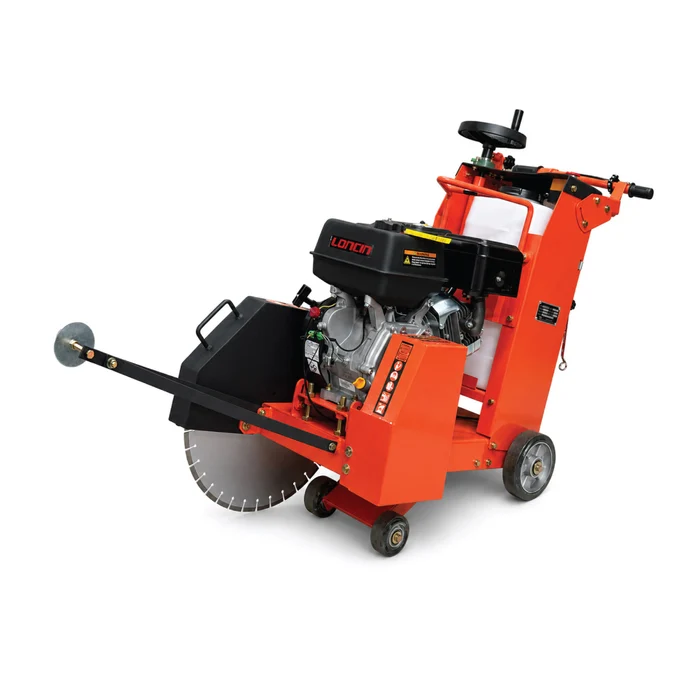
Saws are compared on horsepower, and horsepower decides how fast a cut goes rather than how deep it can be. Depth is geometry. The blade has to reach the bottom of the cut while the arbor and the guard stay above the surface, and no amount of engine changes that relationship. A walk-behind concrete saw has a depth that can be worked out with a ruler before anything is switched on.
Depth is roughly radius minus the flange
On a slab saw, half the blade diameter is the theoretical maximum. From that, subtract the radius of the blade flanges that clamp it, plus clearance for the guard and the arbor housing. On a twenty inch blade that arithmetic lands at a little over seven inches of usable depth rather than the ten the diameter suggests. Anybody specifying a saw against a slab thickness needs the real figure, because a slab that is eight inches thick is not a job for this machine in a single pass.
Stepped cutting and why it is not a workaround
Cutting deep in multiple passes works on a slab saw, and it costs more than people expect. Each pass has to track exactly in the previous kerf, and a blade that wanders even slightly binds against the side of the cut.
A slab saw doing three passes to reach full depth also spends three times as long over the same line, and the blade wears on both faces rather than at the rim. Planning the blade size against the depth is cheaper than planning the passes.
Wet cutting is for the blade, not only the dust
Water suppression is usually discussed as a silica control, which it is and which matters. It is also what keeps the segments from overheating, because a diamond blade removes material by exposing new diamond as the bond wears, and that process depends on temperature.
Run dry and the bond hardens, the segments glaze and the blade stops cutting while the engine sounds unchanged. The operator pushes harder, the blade gets hotter, and the usual next event is a lost segment.
Reading a blade that has stopped cutting
Three symptoms tell different stories:
• Glazed segments mean too hard a bond
• Rapid wear means too soft a bond
• Chipped segments mean impact or rebar
Blade bond is matched to the material being cut, and the rule is counterintuitive: hard material wants a soft bond so the matrix wears away and exposes fresh diamond, while abrasive material like green concrete wants a hard bond that resists being worn back.
Rebar changes the cut and the blade
Hitting reinforcement is not a fault condition on most concrete cutting saw work, but it does change what the blade is doing. Steel loads the segments differently and generates heat quickly, and a blade specified for plain concrete will show it.
Cutting speed has to drop when rebar is reached. Forcing the saw through reinforcement is what produces the chipped segments above, and it is the single most common way an expensive blade is ruined in a few seconds.
Curbs, edges and where a walk behind stops
A slab saw cuts in a straight line from a standing start and needs run on and run off space. Against a wall, in a corner or on a step, there is no way to bring the blade to the surface without cutting into something.
That is where a hand saw takes over, and knowing the limit before mobilizing saves a return trip with a second machine on the truck. The walk behind earns its place on long straight runs where its weight and wheels hold the line better than any operator can.
Depth control is a safety feature
A blade that drops into the cut too quickly can climb out of it, which is the mechanism behind most kickback on a floor saw. A controlled plunge, whether by screw or by hydraulic lever, keeps the blade loading gradually.
The same control matters at the end of a cut. Raising the blade while it is still spinning and still in contact is how operators damage a concrete saw blade and the surface in the same movement.
Reading the specification against the job
Blade diameter, engine power and cutting depth are the listed figures, and only the first two are independent. Water supply arrangement, depth control type, blade guard access and the weight of the machine describe what the day is like.
TMG Industrial builds this one as a 13 horsepower machine taking a twenty inch blade. Measuring the slab, subtracting for flange and guard, and then choosing the blade is the sequence that avoids buying a saw that cannot reach the bottom of the cut.