For anyone managing a block of flats, parcels have become one of the biggest day-to-day headaches. Residents now order everything from groceries to furniture online, couriers arrive throughout the day, and the lobby or concierge desk ends up absorbing the overflow. When a delivery goes missing, residents usually turn to the building team for answers.
That pressure is pushing more managing agents and build-to-rent operators towards residential parcel management software to bring some order to the daily flood. The goal is simple: get every parcel from the courier’s hands to the right resident, with a clear record of each step, and without turning the concierge into a full-time parcel clerk.
Why Apartment Buildings Feel the Pressure Most
Houses have doorsteps, porches, and neighbors. Apartment buildings have a single front door, a shared lobby, and often hundreds of residents receiving deliveries at once. Couriers working to tight schedules can’t wait for each resident to come down, so parcels get left with whoever is available, or worse, simply inside the entrance.
The volume has also changed in character. It’s no longer just the occasional birthday present. It’s weekly food shops, meal kits, prescriptions, clothing returns, and bulky items that don’t fit on a shelf. Peaks around Black Friday and Christmas can double or triple the usual load in a matter of days.
A building designed for post was never meant to be a parcel depot, but many lobbies have become one.
Where the Current System Breaks Down
Most buildings start with a simple approach: a logbook at the concierge desk, a storage room, and a note or text to let residents know something has arrived. It works at low volumes, but it struggles as deliveries increase.
Common problems include:
- Parcels left in communal areas without anyone recording them.
- Handwritten logs that are incomplete, illegible, or out of date.
- Residents not knowing a parcel has arrived until they ask in person.
- Storage rooms filling up with items nobody has collected for weeks.
- No record of who collected a parcel, especially when neighbors pick up for each other.
Each of these creates disputes. Without a reliable record, it becomes one person’s word against another’s, and the building team gets caught in the middle.
The Cost to Residents and Building Teams
For residents, a missing parcel is frustrating and sometimes costly, especially for high-value or time-sensitive items. For building teams, the cost is time and reputation. Concierge staff spend large parts of their shift logging deliveries, answering questions, and searching storage rooms.
In build-to-rent and premium developments, parcel handling has also become part of the resident experience. A smooth, reliable process is now something residents notice and expect, in the same way they expect working lifts or a responsive maintenance team.
Logging Every Delivery at the Door
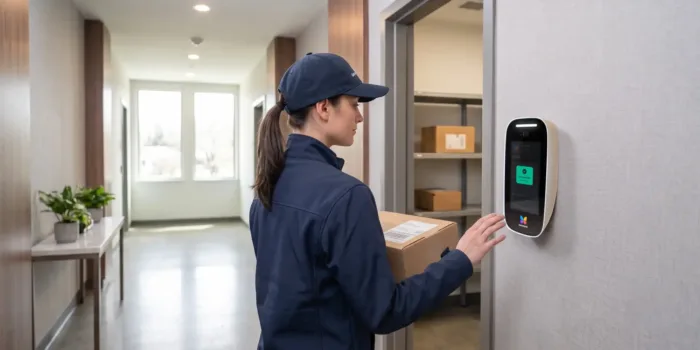
The first and most important change is recording each parcel the moment it arrives. Many buildings now use a tablet or phone to scan the shipping label, which captures the resident’s name, flat number, carrier, and arrival time in seconds. A photo of the parcel adds useful evidence if its condition is later questioned.
This removes the single biggest gap in manual systems. Once a parcel is logged at the door, you can account for it at every step that follows.
Automatic Alerts for Residents
Once a delivery is recorded, the resident receives an automatic email, text, or app notification. They know exactly when it arrived and where to collect it, without having to come down and ask.
Automatic reminders help too. A follow-up after a few days nudges residents who’ve forgotten, which keeps storage space from filling up with uncollected items.
The best parcel process is the one residents barely notice, because their deliveries are simply there when they expect them.
Smarter Storage and Collection
Buildings with growing volumes are rethinking how and where they store parcels. Some assign shelf or bay numbers to each item, so staff can find any parcel in seconds. Others use smart lockers, which let residents collect with a code at any hour, even when the concierge desk is closed.
Whatever the setup, the key is linking each storage location to its digital record. That way, nobody has to search a crowded room to find one small box.
Proof of Collection Closes the Loop
The final step is recording the handover. A signature, a photo, or a confirmed collection in the system shows exactly who took each parcel and when. This is especially useful in buildings where neighbours or flatmates collect on each other’s behalf.
With that record in place, disputes can be settled in minutes rather than becoming lengthy complaints.
Manual vs Digital Parcel Handling
| Manual Approach | Digital Approach |
| Paper logbook at the concierge desk | Label scanned and logged on arrival |
| Residents told by note or phone call | Automatic email, text, or app alert |
| Parcels stacked wherever there’s space | Assigned storage locations or smart lockers |
| No record of who collected an item | Signature or photo captured at handover |
| Disputes resolved by memory | Searchable history for every parcel |
Bringing It Together
Online shopping isn’t slowing down, and apartment buildings will keep receiving more parcels, not fewer. The buildings coping best haven’t simply added more shelves or more staff. They’ve changed how deliveries are recorded, communicated, stored, and handed over.
Logging every parcel at the door, notifying residents automatically, linking each item to a storage location, and capturing proof of collection all work together. The result is a calmer lobby, fewer complaints, and residents who can trust that their deliveries will be waiting for them when they get home.