Quick answer: Cloud-based time and attendance systems are changing UK workforce management by replacing paper timesheets and on-site servers with live, online records of hours, absence and holiday. Managers get real-time visibility, hours flow straight to payroll, and employers can keep the records that UK working time and holiday law expect.
What Are Cloud-Based Time and Attendance Systems?
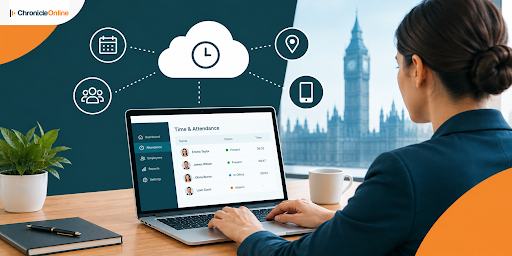
A cloud-based time and attendance system records when people start work, take breaks and finish, then stores that data online rather than on a local server. Managers and staff log in through a browser or app, and software updates arrive automatically.
“Cloud” describes where the data lives, not how people clock in. Clocking terminals, smartphones and tablets can all feed the same system. Our time and attendance software page and the guide to the benefits of cloud-based attendance systems cover the basics in more depth.
Why UK Employers Are Moving Now
Record-keeping duties have widened
Employers have long needed working time records under the Working Time Regulations 1998. From 6 April 2026, the Employment Rights Act 2025 added a duty to keep adequate records showing workers received their holiday entitlement, including people on irregular or zero-hours contracts. Law firm Lewis Silkin notes that failing to keep these records is a criminal offence. The Fair Work Agency began operating on 7 April 2026, although its enforcement powers for these duties did not start immediately.
For practical steps, see our guide to holiday pay record-keeping and the employment rights checklist.
Variable hours are hard to track manually
ONS data cited by workforce vendor Deputy shows over a million people in the UK work on zero-hours contracts. Employment Rights Act reforms on guaranteed hours and shift notice are expected from 2027, with detail still to come through secondary legislation. Employers who track hours accurately now will find those changes easier to handle, particularly where rotas change at short notice (see last-minute shift changes).
Five Ways Cloud Systems Change Workforce Management
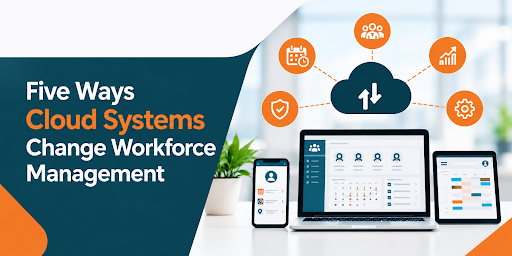
1. Live visibility replaces end-of-week reporting
Managers can see who is in, late or absent as it happens, rather than finding gaps when timesheets arrive. Overtime, breaks and absence patterns appear in reports the same day.
2. Mobile and location-aware clocking
Staff on sites, in the field or working hybrid can clock in through smartphone clocking, where geofencing checks that they are in the right place. This suits sectors such as construction, where teams move between locations.
3. Verified identity
Fingerprint and facial recognition biometric terminals make it harder for one person to clock in for another. Our article on time theft explains why this matters. Biometric data is usually treated as special category data under UK GDPR, so employers typically need a lawful basis and a data protection impact assessment first.
4. Cleaner payroll
When recorded hours transfer directly to payroll software, nobody has to re-key them. Integrations such as Xero reduce transcription mistakes. For more, read how Xero payroll and time app integration supports accuracy.
5. Self-service and smarter scheduling
Employees can view hours and request holidays themselves, and managers approve on the move through a manager app. With self-service and scheduling software, systems can also flag rota patterns that break working time rules, such as the 20-minute break for shifts over six hours or 11 hours’ daily rest.
Cloud vs On-Premise: Key Differences
| Factor | Cloud based | On-premise |
| Updates | Applied automatically | Manual, IT-led |
| Access | Browser or app, anywhere | Usually on-site or VPN |
| Setup cost | Subscription-based | Server and licence costs |
| Multiple sites | One combined view | Often separate installs |
| Maintenance | Handled by provider | Handled in-house |
What to Check Before Choosing a System
- UK rules built in: rest breaks, holiday calculation for part-time and irregular hours, bank holidays.
- Records and audit trail: can you export proof of hours and holiday for each worker?
- Integrations: payroll, HR and accounting links, ideally within a wider workforce management platform and HR software.
- Data protection: where data is hosted, who can access it, and how biometric data is handled.
- Fit for your sector: compare real examples in the case studies and industry pages.
For a fuller buyer’s walkthrough, see our UK time and attendance software guide.
Frequently Asked Questions
What is a cloud-based time and attendance system?
It is software that records working hours, breaks and absence and stores them online, so managers and employees can access them from any device.
Is a time and attendance system a legal requirement in the UK?
No law requires specific software. Employers must keep working time records and, from 6 April 2026, adequate holiday records. The law lets employers choose the format, and software is a practical way to meet both duties.
How long should time and attendance records be kept?
Working Time Regulations records must be kept for at least two years. Law firms advise checking that payroll and HR records for holiday compliance are kept for six years, so many employers keep everything for the longer period. Confirm retention periods with your legal adviser.
Are cloud systems secure?
Reputable providers use encryption, access controls and audit logs. Ask about certifications and hosting location, and confirm how biometric data is handled.
Can cloud systems replace spreadsheets?
Yes. They remove manual re-entry and give a single, auditable record. Our comparison of time and attendance systems vs manual tracking shows the differences in detail.