Nylon straps attract more wrong opinions than any other strap material. Most of them come from owning a bad one. Here are the ones that come up most, and what’s actually true.
Myth 1. All nylon straps are the same
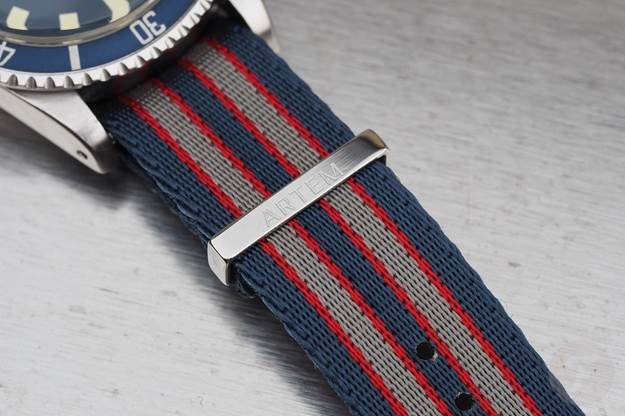
This is the one that does the most damage, because it’s believed by people who’ve only owned the cheap kind. The difference between a $10 nylon strap and a good one isn’t the design, which is nearly identical. It’s the weave density, the edge finishing, the hardware and the keepers. A cheap strap has a loose, shiny weave that softens and frays. A good one is dense and matte and holds its shape for years. Put the two side by side and the gap is obvious. Put them on a wrist for six months and it’s enormous.
Artem’s nylon watch straps are built at the dense end, with sealed edges and a weave designed not to fray. That’s where the price goes.
Myth 2. Nylon is disposable
It was, when the only nylon straps worth buying cost $10 and lasted a season. A well made nylon strap, worn in rotation and dried properly, will go for years. The material doesn’t wear out. The edges and the hardware are what give, and on a good strap neither does.
Myth 3. Nylon looks cheap on a good watch
A bad nylon strap looks cheap on any watch. A good one on a diver or chronograph looks like it was issued with it. The thing that makes a nylon strap look cheap is almost always the hardware. Thin stamped buckles and keepers that slide give the game away. Cast, finished hardware in brushed or polished steel changes the whole impression. Artem fits OEM grade hardware in three finishes, which is the single biggest reason its straps don’t read as budget on an expensive watch.
Myth 4. Nylon straps smell
They do if they’re worn damp day after day and never washed. So does anything. A nylon strap holds moisture in the weave, which means it needs drying after a sweaty day and a wash in warm soapy water every few weeks. Do that and it stays clean. Skip it and any fabric strap will start to turn.
Myth 5. One nylon strap fits every watch
Nylon is more forgiving than leather or rubber, but not infinitely. A 20mm strap in 22mm lugs leaves a gap. A 22mm strap in 20mm lugs bunches. The right answer is a strap cut close to the lug width. Artem’s three sizes, 18mm, 19.5mm and 21.5mm, are cut so that each fills its pair of lug widths cleanly, which is as close to universal as nylon honestly gets.
Myth 6. Nylon is only for divers
Divers are where it looks most natural, but nylon suits field watches, pilot watches, GMTs and chronographs just as well. A navy solid on a chronograph is a classic. A khaki green on a field watch looks correct. Where nylon doesn’t belong is on a dress watch, and even then a plain black nylon on a small steel watch in summer is a look plenty of people pull off.
Myth 7. The stripes are a gimmick
The striped nylon strap has outlived nearly every other strap trend of the last fifty years, which is not what gimmicks do. The reason is that a stripe adds color to a watch in a controlled way. A navy and gray Bond on a black dial diver adds interest without changing the character of the watch. A bold solid does the opposite. The stripes are there because they work.
Artem’s range runs to fourteen, with the Bond, NTTD, Vintage Bond and Blue Bond covering the classic stripes and the Commander, Atlantic Blue and Summer Blue adding variations, alongside solid black, gray, navy, khaki green, burgundy and sandstone.
What’s actually true
A good nylon strap is light, washable, tough, easy to swap and holds the watch on if a spring bar fails. It looks right on most sports watches and wrong on most dress watches. It costs more than a bad one and lasts years longer. It’s not the cheapest strap you can buy and it was never meant to be.
Artem Straps sells its nylon at $76 with a two year warranty and thirty day returns, which is a fair price for a strap you won’t replace next season. The myths come from the straps that cost $10. They don’t apply to this one.